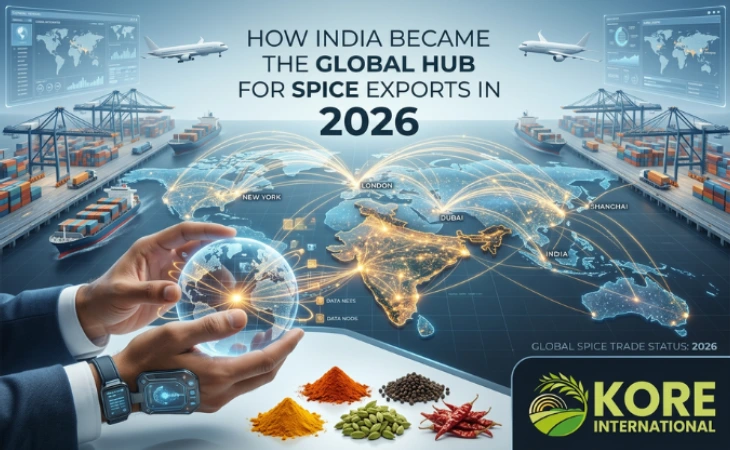
By 2026, India has firmly cemented its position as the world’s leading hub for spice exports, sending over 1.8 million tonnes of spices worth more than $4 billion to more than 180 countries in a single year. With unparalleled diversity, deep rooted farming expertise, and a growing focus on quality and safety, Indian spices suppliers are now the go to partners for global buyers seeking authentic, reliable, and scalable sourcing.
In this piece, we’ll walk you through why India became the global spice superpower in 2026, and how working with the right Indian spices suppliers and spices supplier India partners can give your business a competitive edge.
India grows over 60–75 of the 109 spices recognized by the International Organization for Standardization (ISO), making it the most diverse spice producing country on the planet. This means that from chilli to cardamom, turmeric to cumin, Indian farmers can supply almost the entire spectrum of culinary and food service needs in one place.
Beyond variety, India is also the largest producer, consumer, and exporter of spices globally, supported by a well developed farm to export ecosystem that includes cooperatives, processing units, and logistics networks. For international buyers, this translates into consistent volumes, competitive pricing, and reduced supply chain risk-key reasons why India has become the preferred “spice hub” in 2026.
Recent data shows that India’s spice exports crossed 1.8 million tonnes in a single year, with the value breaching $4 billion, and estimates for 2025–26 already reaching nearly $4.7 billion. This growth is not just about quantity; it reflects a strong global demand for Indian origin raw spices, crushed powders, oleoresins, and value added blends.
India supplies spices to over 180–200 countries, with the top destinations including the USA, China, UAE, Bangladesh, UK, Germany, Malaysia, Thailand, and Saudi Arabia, which together account for more than 60% of India’s spice export earnings. For a spice’s supplier India, this broad based demand means long term contracts, diversified markets, and lower exposure to regional shocks.
Indian spices suppliers benefit from a unique combination of geography, climate, and centuries old farming knowledge, which allows them to grow high quality spices across multiple agro climatic regions. Kerala, Karnataka, Gujarat, Rajasthan, and Andhra Pradesh each specialize in different spices-like Wayanad cardamom, guntur chilli, and rajasthan cumin-enabling buyers to source region specific, organoleptically distinct products.
At the same time, modern Indian spices suppliers are investing in food safety certifications, traceability systems, and quality control labs that meet international standards such as ISO, FSSAI, and many EU level requirements. This gives global buyers confidence that they are not just buying “cheap” spices, but safe, clean, and compliant ingredients that can be used in retail, food manufacturing, and food service chains worldwide.
A major driver behind India’s 2026 spice export boom is the rising global preference for organic and clean label products. Consumers and brands are increasingly wary of pesticide residues and chemical additives, which pushes them toward organic, sustainably farmed Indian spices that carry certifications and transparent sourcing stories.
Leading players-including large Agri brands and niche organic exporters-are scaling up GI tagged and single origin spice lines (such as ITC’s 24 Mantra Organic and other certified organic brands), which command premium pricing and repeat orders. For buyers looking for a spices supplier India that can meet both volume and premium quality demands, this shift opens the door to long term partnerships with certified Indian spices suppliers.
India’s dominance in spice exports is also supported by targeted government schemes, GI tagging, and export promotion initiatives. National bodies oversee everything from seed quality and good agricultural practices to infrastructure for processing, packaging, and logistics, helping local suppliers meet global compliance and scale efficiently.
At events like the International Spice Conference 2026, policymakers and industry leaders have repeatedly emphasized the vision of making India the global processing hub and premier supplier of value added spices, not just a bulk exporter. This strategic push encourages Indian spices suppliers to move up the value chain-offering blends, pastes, and ready to use formulations that can directly serve international kitchens and product portfolios.
For a European food service chain, a Middle Eastern retail brand, or an American meal kit company, partnering with a reliable spices supplier India offers several advantages:
In 2026, more and more buyers are standardizing on a single strong Indian spices supplier as their core partner and then building secondary sources around them, rather than spreading risk across several countries.
When shortlisting an Indian spices supplier India, it helps to focus on a few key checkpoints:
Working with a supplier that ticks these boxes not only reduces your operational risk but also strengthens your brand’s reputation for safe, authentic, and high quality spices.
Today, Indian spices are not just “Indian” anymore-they have become core ingredients in global cuisines, from fast food chilli sauces and health drink turmeric shots to artisanal spice blends for fine dining restaurants. International chefs and food scientists increasingly rely on Indian spices suppliers to provide stable, standardized spice profiles that can be replicated across continents.
For example, Guntur Teja chilli from India is now a favourite among hot sauce manufacturers worldwide for its intense pungency and vibrant red colour, while Kerala grown cardamom is in high demand due to shortages in Guatemala and a perception of superior flavour and higher volatile oil content. These shifts show that the “India for spices” narrative is not just about low cost, but about quality, reliability, and flavour authority.
India’s vision for the spice sector is moving from bulk exports to branded, value added products. In 2026, leading policymakers are urging the industry to invest more in technology driven processing, fortified blends, and functional spices (such as high curcumin turmeric or low salt spice mixes) that can command higher margins in global markets.
For buyers, this means more opportunities to co create private label spice ranges with Indian spices suppliers that can carry your brand story, your quality standards, and your target market positioning. In other words, partnering with the right spices supplier India today is not just about sourcing ingredients-it’s about building a long term, scalable, and differentiated product line.
If you treat your Indian spices supplier as a strategic partner rather than a mere vendor, you can leverage India’s natural strengths-diversity, quality, and reliability-to future proof your supply chain and delight your customers in 2026 and beyond.