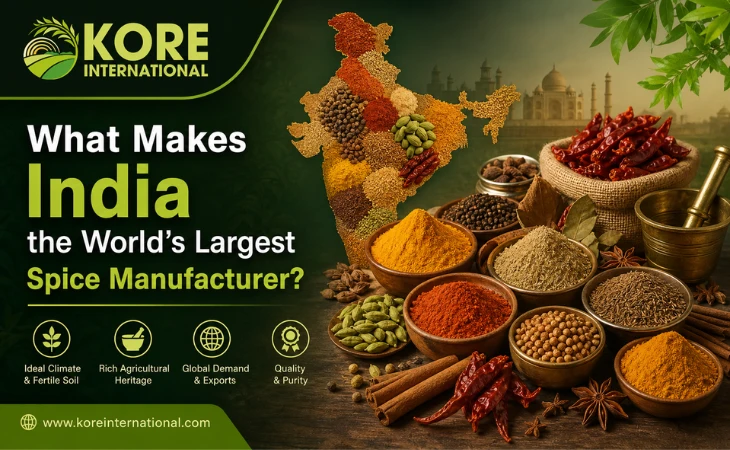
Walk into any food market anywhere in the world - from a supermarket in Toronto to a spice souk in Dubai - and the odds are high that the turmeric, cumin, or chilli on the shelf started its journey in India. That is not a coincidence. India produces over 75 different varieties of spices, accounts for nearly 30% of global spice production, and has held the title of the world's largest spice-producing nation for decades. But the numbers alone do not tell the full story.
For any business sourcing from a spice’s manufacturer in India - whether you are a food brand, a wholesaler, or a spice blending company - understanding what drives this scale is not just interesting background knowledge. It directly shapes the quality, consistency, and pricing of what you buy.
Here is a clear look at the real reasons India dominates global spice manufacturing, and why that position is not going anywhere.
India sits between the Tropic of Cancer and the equator, which means it holds an extraordinary range of climates within a single country. The humid coastal plains of Kerala are perfect for black pepper and cardamom. The dry, semi-arid soils of Rajasthan produce some of the finest cumin and coriander in the world. Gujarat's black cotton soil is ideal for sesame and fennel. Andhra Pradesh and Telangana supply the bulk of India's red chilli crop.
This regional diversity means India does not depend on a single growing zone. When one area has a difficult season, other regions compensate. No other country has this geographic spread combined with the infrastructure to process and export at scale.
The soil chemistry, altitude variation, and rainfall patterns across Indian states create spice profiles with distinct flavour intensity and essential oil content - which is why Indian turmeric has a higher curcumin percentage than most competing origins, and why Byadgi chilli from Karnataka is prized globally for its deep red colour rather than just heat.
Spice cultivation in India is not a modern industry. It predates most written history. Farmers and processors in spice-growing regions carry knowledge that has been passed down through generations - knowledge about when to harvest, how long to dry, what moisture levels affect shelf life, and how to preserve the volatile oils that give each spice its potency.
That depth of expertise shows up in consistency. An experienced whole spice processor in India can assess quality by touch, smell, and visual inspection in ways that laboratory tests confirm but cannot replace. This is not romanticising tradition - it is a genuine competitive advantage. Spice quality is deeply sensory, and that sensory expertise exists in Indian supply chains at every level.
When you source from an established Indian whole spices manufacturer, you are not just buying a product off a shelf. You are buying into a supply chain where knowledge about that specific spice runs very deep - from how it was grown to how it was cleaned, graded, and packed.
India produces approximately 11 to 12 million metric tonnes of spices annually. The country exports to over 180 countries. In the 2022–23 financial year alone, spice exports crossed USD 4 billion. These figures translate into something very practical: when you need to place a large order, India has the supply depth to fulfil it without driving up market prices or facing availability gaps.
Smaller producing countries simply cannot match this. A buyer needing 50 tonnes of cumin seeds in a single shipment has far fewer reliable options outside of India - and most of those options will eventually source from Indian stock anyway.
Beyond raw production, India has invested significantly in post-harvest processing infrastructure. Cleaning plants, steam sterilisation units, cold storage chains, and advanced packaging facilities are now widespread among serious exporters. This matter because raw field output alone does not pass international food safety requirements - it needs to be cleaned, sorted, tested for moisture and contamination, and packaged correctly.
The gap between a basic farmer-level supply and an export-ready, certified spices manufacturer in India is significant. The best manufacturers in the country have bridged that gap entirely.
One of the biggest shifts in the Indian spice export industry over the past decade has been the widespread adoption of internationally recognised certifications. FSSAI compliance is now a baseline requirement. Serious exporters also hold APEDA registration, Spices Board certification, ISO 9001, and increasingly, BRCGS, US FDA registration, and Halal and Organic certifications.
These are not just stamping on a document. Each certification reflects a system of testing, traceability, hygiene controls, and documented processes. For buyers importing into markets like the US, EU, Japan, or the Middle East - where regulatory requirements are strict - these certifications reduce risk significantly and simplify customs clearance.
The Indian government has also played an active role here. The Spices Board of India, operating under the Ministry of Commerce, supports quality testing laboratories, funds export promotion programmes, and maintains quality standards for Indian spice exports. That institutional backing gives buyers an additional layer of confidence that simply does not exist in many competing origin countries.
India's cost structure for spice production remains highly competitive globally. Lower land costs in rural farming regions, an experienced agricultural labour force, and efficient domestic logistics mean that spices can be grown, processed, and shipped at price points that other producing countries struggle to match.
This is worth saying clearly: competitive pricing in Indian spice manufacturing is a result of structural economic advantages, not a sign of compromised quality. When you buy certified, tested, properly processed whole spices from a reputable Indian manufacturer, you are getting genuine value - not a cheaper product that cuts corners on safety or purity.
That said, price should never be the sole selection criterion. The difference between a commodity trader and a serious indian whole spices manufacturer is visible in quality documentation, batch testing reports, and packaging standards. Buyers who ask for these details upfront invariably get better outcomes.
India's spice trade routes predate modern shipping by centuries. The country has been supplying spices to Arab traders, European merchants, and Asian markets for over two thousand years. What this long history has created is a deeply embedded export culture - one where documentation, relationship management, and international compliance are embedded in how businesses operate, not bolted on as an afterthought.
Today, that translates into experienced export teams who understand incoterms, phytosanitary certificates, fumigation requirements, and how to handle regulatory queries from buyers across different countries. For a first-time importer, working with an established Indian spice manufacturer is often far smoother than navigating newer export markets.
The support infrastructure around the industry - freight forwarders, testing labs, certification bodies, port logistics - is also highly developed in major spice-exporting states like Gujarat, Rajasthan, and Kerala. That ecosystem makes the entire sourcing process faster and more reliable.
India's position as the world's leading spices manufacturer is the result of geography, generational knowledge, processing scale, and a trade infrastructure that has been refined over centuries. None of those advantages appeared overnight, and none of them are easily replicated elsewhere.
For buyers, the real task is not finding a country to source from - that answer is clear. The real task is identifying the right manufacturer within India: one with verified certifications, transparent quality processes, and the export experience to make your sourcing reliable shipment after shipment.
If you are in the process of evaluating suppliers, start by asking for quality certifications, moisture test reports, and references from buyers in your region. Those three questions alone will quickly separate the serious players from the rest.