If you've ever tried to find the right spices wholesale market in india - the kind that actually supplies the authentic, high-grade product your business needs - you already know the search can feel overwhelming. There are hundreds of suppliers, dozens of markets, and a sea of certificates and claims that all start blurring together.
Here's the truth: India is the world's single largest producer and exporter of spices. As of FY 2024–25, the country exported spices worth USD 4.72 billion across 200 destinations worldwide. And behind that massive number are a handful of specific wholesale markets that make the entire machine run.
At Kore Agro International, we've been sourcing, processing, and exporting spices since 2015 - currently reaching buyers in over 81 countries. One of the most valuable things we've learned in that journey is this: knowing which spices wholesale market your product comes from tells you almost everything about its quality, grade, and price.
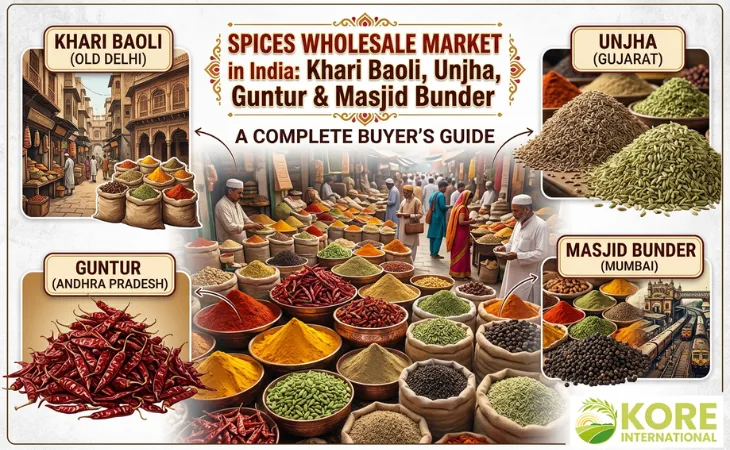
This guide walks you through the four most important spices wholesale markets in India - Khari Baoli, Unjha, Guntur, and Masjid Bunder - so you can understand exactly where the world's best spices come from and what to look for when you're sourcing them.
Before we get into the individual markets, it helps to understand the scale of what we're talking about.
India contributes approximately 80% of the world's cumin supply, 70% of turmeric, 60% of chilli, and 96% of black pepper. These aren't crops grown and sold in a scattered, informal way - they flow through organized, large-scale market yards called APMCs (Agricultural Produce Market Committees), where daily auctions set prices that ripple across global commodity markets.
The four markets below - Khari Baoli in Delhi, Unjha in Gujarat, Guntur in Andhra Pradesh, and Masjid Bunder in Mumbai - collectively handle the majority of India's spice trade. If you're sourcing bulk spices from India, chances are your product passed through at least one of them.
Let's take them one by one.
If you visit Old Delhi and follow your nose through the maze of Chandni Chowk, you'll eventually reach Khari Baoli - a narrow road that has been trading spices since the 17th century. The market traces its origins to the Mughal era, and some of the shops operating there today are run by the tenth or twelfth generation of the founding families.
The name "Khari Baoli" translates loosely to "salty stepwell," named after a brackish stepwell (baoli) that once stood at the site. The well is long gone, but the market it gave rise to is very much alive - and, by most accounts, the largest wholesale spice market in Asia.
Located at the western end of Chandni Chowk, adjacent to the Fatehpuri Masjid and within sight of the historic Red Fort, Khari Baoli handles an estimated 1,000+ tonnes of spices daily. The Gadodia Market, built in the 1920s on the southern side of Khari Baoli, forms the commercial heart of the area - a three-story godown complex that houses wholesale dealers, storage areas, and the rooftop with its famous view of Old Delhi.
What's Traded HereKhari Baoli is not a single-spice market. It's more like a concentrated spice universe. You'll find:
The market serves buyers from across North India - including Jammu & Kashmir, Rajasthan, and Madhya Pradesh - and supplies spices to restaurants, hotels, processors, and exporters throughout the country.
What Makes It Unique for Bulk BuyersFor international buyers or top Indian spices exporters sourcing through intermediaries, Khari Baoli is the benchmark. Prices here influence wholesale rates across North India, making it a reliable reference point even if you're eventually sourcing directly from a farm or processing unit.
Practical NotesIf you want cumin seeds, there is one place on earth where the price is ultimately decided: Unjha, a town in Mehsana district, Gujarat.
Established in 1954 as Gujarat's first APMC, the Unjha market yard now spans 36 acres and hosts around 800 commission agents. It trades cumin (jeera), fennel (variali), fenugreek, mustard, and dill seeds - but it's cumin that put Unjha on the global map.
During FY 2024–25, Mehsana district alone exported cumin and spice seeds worth approximately ₹3,995 crore to 101 countries. Major buyers include China (25%), Bangladesh (16%), UAE (10%), the USA (5%), and Morocco (4%). In early 2025, Unjha APMC recorded cumin seed arrivals of 54,410 metric tonnes between February and April - a 17.5% jump compared to the previous year.
How the Auction System WorksEvery day, farmers from Gujarat and Rajasthan bring their produce to Unjha. Seeds are auctioned in an open format - piled high in the open yard, inspected visually by buyers, and auctioned off one pile at a time by licensed auctioneers surrounded by a group of competing buyers.
International buyers cannot participate directly in this auction system. The market runs on deep local relationships. This is why working with an established exporter - one with genuine roots in the Unjha ecosystem - is so important.
Cumin Grades You Need to KnowNot all cumin from Unjha is the same. There are distinct trade grades:
The cumin from North Gujarat (particularly from the Banaskantha and Patan districts) is considered superior in quality due to the region's agro-climatic conditions. Higher volatile oil content (2–3%) and lower moisture give Unjha cumin its distinctive aroma and flavour.
Why This Market Matters for Global BuyersUnjha doesn't just sell cumin - it sets the price for it globally. The daily auction results at Unjha market are broadcast on All India Radio (Baroda centre) and published in leading newspapers and on Agmarknet. These prices are tracked by commodity traders, importers, and food manufacturers worldwide.
The current Unjha cumin price as of April 2026 is approximately ₹196–208/kg (Agmarknet/NCDEX). For buyers planning procurement, monitoring Unjha auction trends is an essential part of the decision-making process.
Practical NotesThere's a reason Guntur is called the Chilli City of India. This district in Andhra Pradesh produces 15% of India's entire chilli output, and Andhra Pradesh as a state contributes 40% of India's total chilli production. The Guntur Mirchi Yard is widely recognized as Asia's largest chilli market - a distinction backed by both volume and the global pricing power it commands.
Every year, Guntur handles somewhere between 5 to 6 lakh tonnes of chilli - red, dried, whole, stemless, and powdered - destined for kitchens, food processors, and spice manufacturers across India and the world.
The Varieties That Made Guntur FamousGuntur is home to several chilli varieties that have earned GI (Geographical Indication) tags and international recognition:
Guntur Sannam (S4): Perhaps the most famous Guntur chilli variety in the world. Known for its rich red colour and high pungency (35–45 SHU in ASTA terms), Sannam has GI tag status and is widely used for pungency and capsaicin extraction. Annual production: approximately 280,000 tonnes.
Teja (S17): The fiery queen. One of the hottest commercially available Indian chilli varieties. Popular for international buyers, exported stemless, with stem, and as powder. Used widely in soups, stir-fry, stews, and industrial spice blends.
Byadgi: Prized for its deep colour over pungency - the red that makes chilli oils, paprika, and premium spice blends vibrant. Extremely popular with European food manufacturers.
Byadgi: Prized for its deep colour over pungency - the red that makes chilli oils, paprika, and premium spice blends vibrant. Extremely popular with European food manufacturers.
The Mirchi Yard and How It WorksThe Guntur Mirchi Yard is the primary trading hub. Prices set here influence chilli rates across India and are tracked on the National Agriculture Market (e-NAM) platform. Daily arrivals of chilli lots are auctioned, with buyers ranging from domestic masala manufacturers to international export houses.
The best time to buy chilli from Guntur is February to mid-April, during peak harvest. This is when arrivals surge by as much as 70%, prices dip to their annual lows, and quality is at its freshest - low moisture (8–10%), high ASTA colour values, and minimal aflatoxin risk.
Experienced buyers arrive between 5–8 AM on weekdays for the freshest lots and best negotiating conditions.
What to Check Before You BuyIf you're sourcing chilli from Guntur - whether directly or through an exporter - here's what quality-conscious buyers look for:
Mumbai's Masjid Bunder market, nestled in the Dongri area, has a different origin story from the land-based markets above. It grew up around Bombay's docks in the 19th century - shaped by centuries of Arabian Sea trade that brought Malabar pepper, Gujarat cumin, and coastal spices through one of India's busiest ports.
Today, Masjid Bunder's sprawling godowns handle approximately 500 tonnes of spices daily, contributing an estimated ₹5,000 crore in annual turnover and accounting for roughly 20% of Maharashtra's spice exports.
The Role It Plays in India's Spice TradeWhile Khari Baoli is the diversity capital and Unjha and Guntur are production specialists, Masjid Bunder plays a different role - it's primarily a distribution and re-export hub.
Spices arrive at Masjid Bunder from production markets across India (Unjha cumin, Guntur chilli, Kerala pepper and cardamom, Erode turmeric). Here they are consolidated, processed, blended, packaged, and sent to:
For top Indian spices exporters focused on Middle Eastern markets, African markets, or buyers in the Gulf, Masjid Bunder's location is a logistics advantage. Mumbai's port infrastructure enables faster, more economical sea freight to these destinations than interior markets can offer.
The market also has deep connections to foil-lined packaging specialists, which are important for aroma retention in long-haul export shipments. Buyers who want consistent packaging standards alongside quality sourcing often find Masjid Bunder's traders well-equipped.
What's AvailableYou now have a picture of four very different markets, each with a distinct specialisation. Together, they form the backbone of every spices wholesale market in India:
| Market | Location | Speciality | Why It Matters |
|---|---|---|---|
| Khari Baoli | Old Delhi | Full spice variety, North India hub | Best for variety, benchmark pricing |
| Unjha | Mehsana, Gujarat | Cumin, fennel, seed spices | Sets global cumin prices |
| Guntur | Andhra Pradesh | Red chilli (all varieties) | Asia's largest chilli market |
| Masjid Bunder | Mumbai | Distribution, export hub | Logistics gateway to global markets |
What this map tells you is that sourcing great Indian spices isn't about finding one supplier in one place. It's about understanding the origin, the grade, and the supply chain from farm to port.
Whether you're buying cumin from Unjha, chilli from Guntur, or a full spice range from an integrated exporter, here's what separates reliable partners from risky ones:
Certifications are non-negotiable. For any serious bulk buyer, look for: FSSAI, ISO 9001, APEDA, Spice Board of India, HACCP, and where applicable - USDA Organic, EU Organic, Halal, and BRCGS. These aren't just badges; they represent systems of traceability, hygiene, and accountability.
Lab test reports matter. Especially post-2024, after EtO (ethylene oxide) bans and aflatoxin alerts impacted Indian spice exports, buyers in the EU and USA now expect pesticide residue test reports as a standard part of every shipment. A credible exporter provides these proactively.
Packaging protects your investment. Bulk spices are sensitive to moisture and oxidation. Look for moisture-proof, airtight, food-grade packaging - 25kg or 50kg jute-lined PP bags, vacuum-sealed pouches, or HDPE bags depending on the spice and transit duration.
Experience shows in the details. An exporter who has been operating for years, who has relationships with growers in Unjha, Guntur, and Kerala, and who has navigated international trade documentation across dozens of markets - that's expertise that protects your supply chain.
Since 2015, Kore Agro International has been building exactly this kind of supply chain - one that draws from the best source markets in India and delivers to buyers in over 81 countries with consistent quality and certified reliability.
We source whole chilli from Guntur, cumin from Unjha, turmeric fingers from the best-growing belts of India, and consolidate everything through our processing facility - with zero artificial colours or pesticides, moisture-free packaging, and certifications including FSSAI, ISO, APEDA, Spice Board, Halal, BRCGS, and USFDA compliance.
Our export value has grown from USD 1.2 million in 2015 to USD 28.33 million in 2024 - not because we shout the loudest, but because our buyers keep coming back.
If you're ready to buy from the right spices wholesale market in India - whether you need a single container of cumin or a full regular supply program - we'd love to talk.
Khari Baoli in Old Delhi is Asia's largest wholesale spice market by variety and daily volume. For individual commodities, Unjha (cumin) and Guntur Mirchi Yard (chilli) are the world's largest for their respective spices. Each spices wholesale market in India has a distinct speciality - no single market covers everything.
Where do top Indian spices exporters source their products?Most top Indian spices exporters maintain direct sourcing relationships with farmers and APMC markets in Guntur (chilli), Unjha (cumin and seed spices), Erode and Nizamabad (turmeric), and Kerala (cardamom and black pepper). They then process, clean, and pack at their own facilities before export.
Is it possible to buy directly from these wholesale markets as an international buyer?For markets like Unjha, direct participation in local auctions is not practical for international buyers - the system runs on complex local relationships and licensed agents. The right approach is to work with a certified, established Indian spice exporter who sources from these markets and can handle quality checks, documentation, and logistics on your behalf.
What certifications should I look for in an Indian spice exporter?At minimum, look for: FSSAI (India's food safety authority), ISO 9001 (quality management), APEDA (agricultural exports), Spice Board of India certification, and HACCP. For organic buyers, add USDA Organic or EU Organic. For buyers in Islamic markets, Halal certification. For premium retail and food service, BRCGS.
When is the best time to buy chilli from the Guntur spice market?The best buying window is February to mid-April, during peak harvest. This is when arrivals are highest, quality is freshest, and prices are at their annual lows. Mid-week visits (Monday to Thursday) offer better negotiating conditions.