
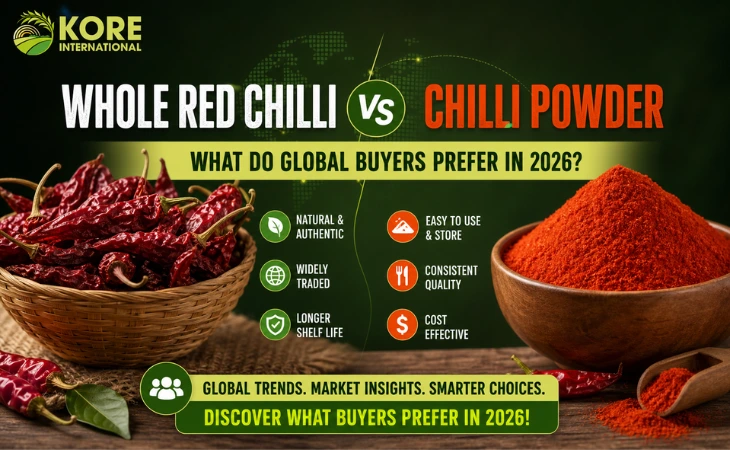
When it comes to sourcing red chilli from India, one question comes up again and again in buyer conversations: "Should I import whole red chilli or chilli powder?" It sounds simple. But the answer can impact your product quality, shelf life, pricing, and processing flexibility in ways you might not expect.
If you're a food manufacturer, spice trader, or distributor looking to make the right sourcing decision - you're in the right place. Let's break this down together.
Red chilli is one of India's most exported spices. As a leading Indian whole spices manufacturer and exporter, Kore Agro International ships to over 81 countries - and we've seen firsthand that buyers across different regions have very different preferences when it comes to chilli format.
The choice between whole red chilli and chilli powder isn't just about convenience. It affects:
Understanding these differences is the first step to making a smarter, more profitable sourcing decision.
Whole red chillies are dried naturally or by machine, cleaned, and sorted to meet export quality standards - typically with moisture levels maintained at around 12%. They are exported with or without stems depending on buyer specifications.
Food manufacturers and large processors are the most consistent buyers of whole chilli. Why? Because they want control.
When you receive whole chilli, you can:
Countries like Thailand, Indonesia, and Vietnam are strong buyers of whole dried chillies in bulk because they prefer local grinding and blending as part of their food processing operations.
"The key advantage of whole chilli is flexibility. You're not locked into someone else's grind size, heat level, or blend."
For businesses with in-house processing capabilities, whole red chilli from a trusted Indian spices supplier gives you the raw material and the freedom to create your own product profile.
Red chilli powder is processed, dried, and ground to a fine or coarse consistency. Moisture is typically kept at around 10% to reduce spoilage risk during transit. It comes ready to use - no grinding equipment needed.
Retailers, packaged food brands, and smaller food businesses often prefer chilli powder because it saves processing steps and reduces the need for heavy machinery.
Chilli powder buyers typically include:
Global food chains in particular have been increasingly shifting toward certified bulk chilli powder exporters - because for a multinational brand, flavor consistency across every batch, every market, every season is non-negotiable.
| Feature | Whole Red Chilli | Chilli Powder |
|---|---|---|
| Shelf Life | Longer (when stored correctly) | Shorter (color & pungency degrade faster) |
| Processing Required | Yes - grinding needed | No - ready to use |
| Quality Verification | Easy visual inspection on arrival | Harder to assess without lab tests |
| Flavor Control | High - you control the grind | Fixed by the exporter |
| Moisture Requirement | ~12% for export grade | ~10% for export grade |
| Best For | Food manufacturers, processors | Retailers, packaged food brands |
| Price Point | Generally lower per kg | Higher due to value-added processing |
| Visual Appeal | Natural, whole appearance | Uniform, fine-ground appearance |
One of the most interesting things we observe as an Indian whole spices manufacturer with exports to 81+ countries is that buyer preferences are deeply regional.
These markets strongly prefer whole dried chillies in bulk. Local processors grind and blend according to regional taste profiles. Whole chilli gives them the raw material to produce their market-specific products.
The US - the top high-value chilli market - has seen a growing demand for both formats, but with increasing emphasis on certified organic and traceable products. Buyers here want documentation, lab reports, and certifications like USDA Organic, FSSAI, and FDA compliance, regardless of format.
European buyers are moving strongly toward organic-certified chilli in both whole and powder forms. Clean-label demands are high. Buyers want to know the farm of origin, the growing practices used, and the pesticide-residue test results.
These regions prefer whole chilli and coarsely crushed flakes for use in traditional cooking and local spice blending. Halal certification is often a requirement.
An emerging market with growing demand - primarily for whole chilli as the region develops its own local processing infrastructure.
Still not sure which format is right for your business? Here are three questions that will guide your decision:
If yes, whole chilli gives you better value and more control. If no, powder saves you significant investment.
A chilli sauce brand needs exact color values (ASTA) and consistent heat (SHU). An Indian restaurant just needs great-quality ground chilli. Match the format to the end use.
If your transit and storage times are long, whole chilli tends to hold its quality better - especially when moisture is properly controlled.
India accounts for approximately 36% of global chilli production and nearly half of the world's spice trade. No other country comes close to matching India's combination of:
When you work with a certified Indian spices supplier, you're not just buying chilli - you're accessing decades of agricultural expertise, established export protocols, and a supply chain built to handle global buyer requirements.
At Kore Agro International, we've been exporting whole spices and agricultural products since 2015. Today, we serve buyers in 81+ countries with:
Whether you're a first-time importer or a large-scale food manufacturer scaling your supply, our team is ready to guide you to the right chilli format and specification for your business.
So - whole red chilli or chilli powder? The honest answer is: it depends on you.
Whole red chilli is ideal if you want flexibility, longer shelf life, and processing control. Chilli powder is the right choice if you need a ready-to-use product with consistent quality and no processing overhead.
What both options share is this: when they come from a trusted, certified Indian whole spices manufacturer, you can count on quality, compliance, and consistency - batch after batch, shipment after shipment.
Have questions about which format is right for your business? Our team at Kore Agro International is happy to help. Reach out to us, and let's find the best solution together.